Hybrid work makes payroll more complex—multiple schedules, locations, overtime rules, allowances, and time-off patterns. That complexity can either create confusion (“Why is my pay different?”) or clarity—when payroll technology turns pay into a visible, trackable process employees and managers can understand. Xerosoft Global can support this shift by implementing payroll workflows that are transparent by design: self-service, clear approvals, integrated time data, and real-time reporting.
Key Benefits

Employee self-service = fewer “mystery payslip” moments
Modern payroll systems commonly include employee self-service portals so staff can view payslips, tax documents, and update details without waiting on HR—especially useful for hybrid teams that aren’t always onsite.
Transparency win: employees can verify the inputs (time, allowances, deductions) earlier, reducing disputes after payroll runs.

Integrated time + attendance reduces pay disputes
A major driver of payroll confusion in hybrid setups is mismatched time data (manual timesheets, late edits, different systems). Integrating time tracking with payroll reduces manual entry and improves accuracy.
Transparency win: employees can see how approved hours translate into gross pay—cleaner audit trails, fewer corrections.

Real-time reporting helps managers catch issues before payday
When payroll processing is automated and data is centralized, companies can surface exceptions earlier (missing punches, overtime spikes, allowance changes). Some HR/payroll automation approaches emphasize real-time insights and faster payroll processing by reducing re-entry and consolidating workflows.
Transparency win: fewer “surprise” adjustments and fewer retro-pay situations.

Stronger access controls build trust in payroll data
Hybrid work increases access points (home networks, mobile devices). Payroll transparency only works if employees trust the system’s integrity. Cloud security guidance stresses the shared responsibility model—organizations must configure controls properly (like MFA and access governance).
Transparency win: clearer accountability over who changed what, and better protection against payroll diversion or unauthorized edits.

Multi-location compliance becomes easier to explain
Hybrid teams often create multi-jurisdiction payroll complexity (different local taxes/rules). Payroll platforms and processes designed for multi-location compliance reduce errors and improve clarity in “why” the calculation differs by location.
Transparency win: fewer confusion points for employees who split time across locations.
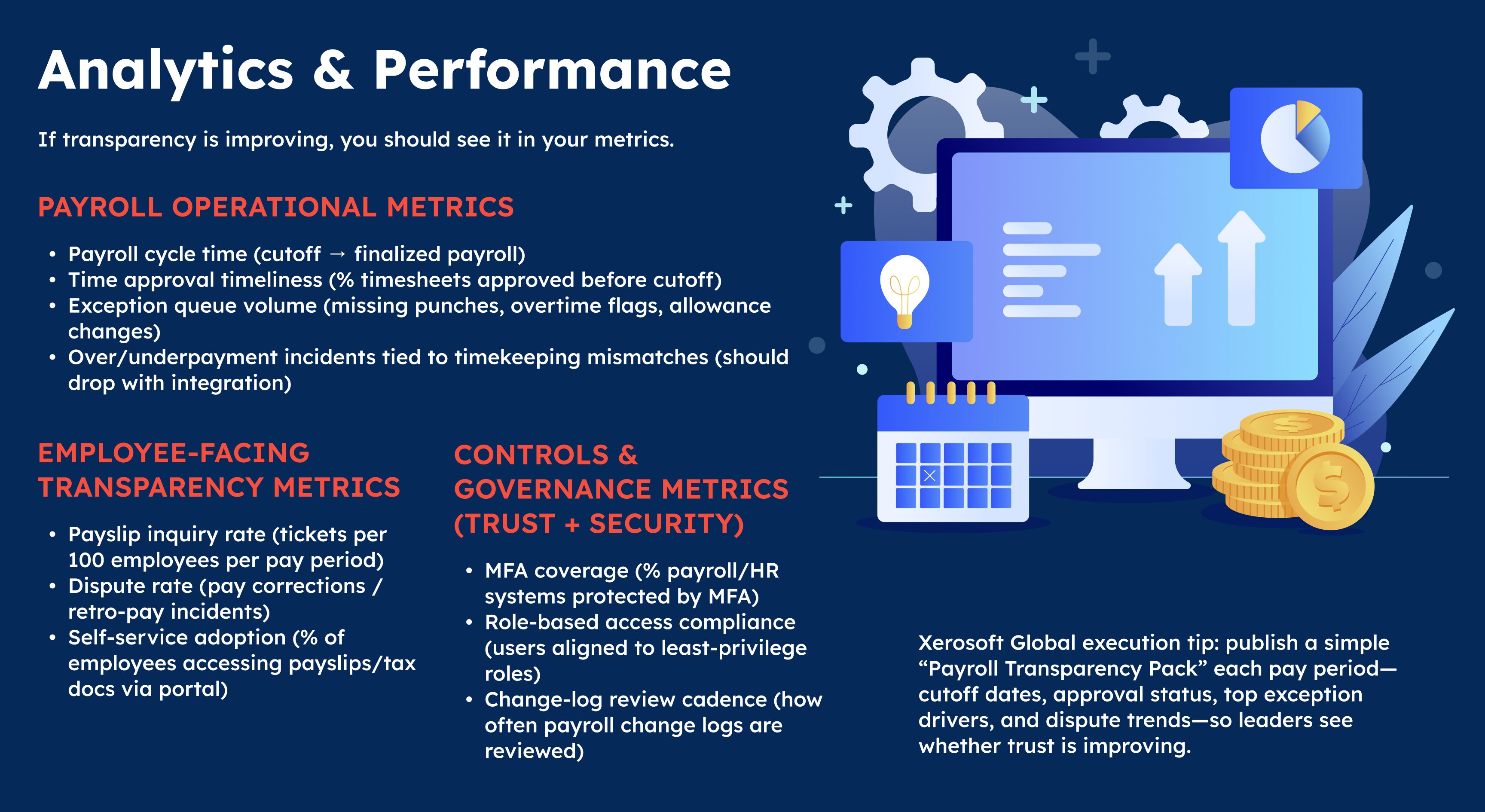
Where Xerosoft Global fits: Xerosoft Global can package payroll transparency as a rollout: ESS portal + integrated timekeeping + approval workflows + exception dashboards + security controls—so hybrid payroll becomes predictable and explainable.

Conclusion
In hybrid work models, payroll transparency is no longer optional—it’s a retention and trust lever. Payroll tech improves transparency by giving employees self-service visibility, tying time data directly to pay outcomes, surfacing exceptions earlier, and strengthening controls around sensitive payroll information.
With the right setup, Xerosoft Global can help organizations turn payroll from a black box into a clear, auditable, employee-friendly process.
References
- Workday — Payroll automation and employee self-service
- Rise Works — HR and payroll integration (employee self-service portal)
- Paychex — Integrating time tracking and payroll
- Arcoro — Benefits of time tracking + payroll integration
- IRIS Global — Payroll guide to remote and hybrid work compliance