Scaling is when bookkeeping shifts from “recording transactions” to running a financial operating system. More invoices, more payment methods, more tools, more staff—without tighter processes, growth creates messy data, slow closes, cash surprises, and reporting you can’t trust. The goal in 2026 is simple: keep books continuously clean so leadership decisions stay fast and accurate—and that’s exactly where Xerosoft Global can add leverage.
Key Benefits

Faster closes without the month-end panic
Growing businesses can’t afford to wait until period-end to discover missing transactions or miscodings. Moving toward a “continuous close” approach—completing close tasks throughout the month—reduces bottlenecks and improves visibility.

Fewer errors as transaction volume explodes
The most common scaling pain is rework: duplicated entries, miscategorizations, and unreconciled balances that compound each month. Continuous processes and standardization help reduce risk and manual mistakes.

Better cash control (runway, working capital, and timing)
Cash doesn’t fail because of revenue—it fails because of timing. Good bookkeeping is a prerequisite for reliable cashflow forecasting because your A/R, A/P, and actual spend need to be current and accurate.

Stronger governance as more people touch the books
As you add staff and tools, access sprawl becomes a real risk. Cloud tools help—but security is a shared responsibility: the vendor secures the platform, while the business must configure access, controls, and practices like MFA.
Where Xerosoft Global fits: Xerosoft Global can implement a scalable bookkeeping cadence (weekly reconciliations + standardized close + controls) so growth doesn’t degrade reporting quality.
Common Growing Pains (and how to prevent them)
Growing pain #1: “Our numbers change every time we look at them.”
Fix: lock a clear workflow:
- daily/3x-weekly bank feed review
- weekly reconciliation targets
- monthly close checklist with approvals
Continuous close discipline is designed to reduce this kind of instability.
Growing pain #2: “We’re using too many tools and nothing matches.”
Fix: define a single source of truth (usually the GL), then enforce mapping rules:
- consistent chart of accounts aligned to how you manage the business
- standardized categories for payroll, marketing, software, COGS
- documented policies for reimbursements and subscriptions
Growing pain #3: “Reconciliations take forever.”
Fix: automate where it’s safe, review where it matters. Bank reconciliation automation is widely cited as a time saver that can also improve accuracy compared to manual approaches—especially when exceptions are handled with clear review rules.
Growing pain #4: “We don’t feel secure letting more people into finance systems.”
Fix: access governance:
- role-based permissions by job function
- MFA for business-critical systems
- scheduled access reviews (especially after role changes)
Conclusion
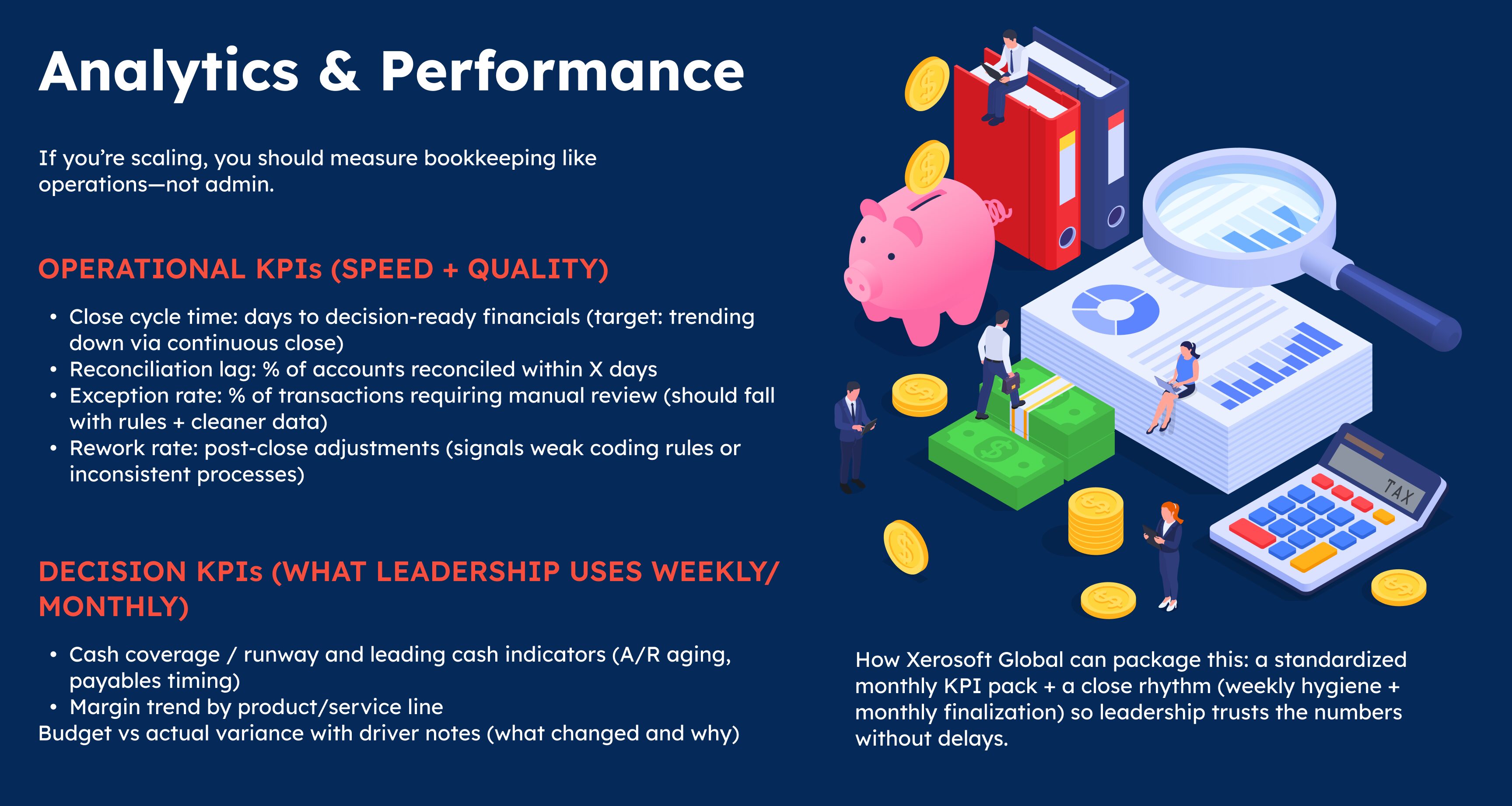
Scaling businesses don’t “outgrow bookkeeping”—they outgrow informal bookkeeping. The winning move in 2026 is building a continuous close rhythm, automating high-volume work (especially reconciliations), tightening security controls, and tracking performance KPIs that keep reporting decision-ready.
With the right operating model, Xerosoft Global can help growing companies avoid the classic pain cycle (messy books → slow close → bad decisions) and replace it with repeatable financial clarity.
References
- Oracle NetSuite — Continuous Close (what it is and how it helps)
- Trintech — Benefits of a continuous close (standardization, reduced risk, time savings)
- UK NCSC — Cloud security shared responsibility model
- New Zealand NCSC — Multi-factor authentication guidance
- Numeric — Automating bank reconciliations (time + accuracy benefits)