“Data-driven bookkeeping” means your books aren’t just accurate—they’re timely, structured, and analysis-ready, so leaders can make decisions continuously (not after month-end). In 2026, this is quickly becoming the new baseline because businesses need faster visibility, regulators expect cleaner audit trails, and automation is reducing the cost of producing real-time insights.
Key Benefits

From compliance reports to decision systems
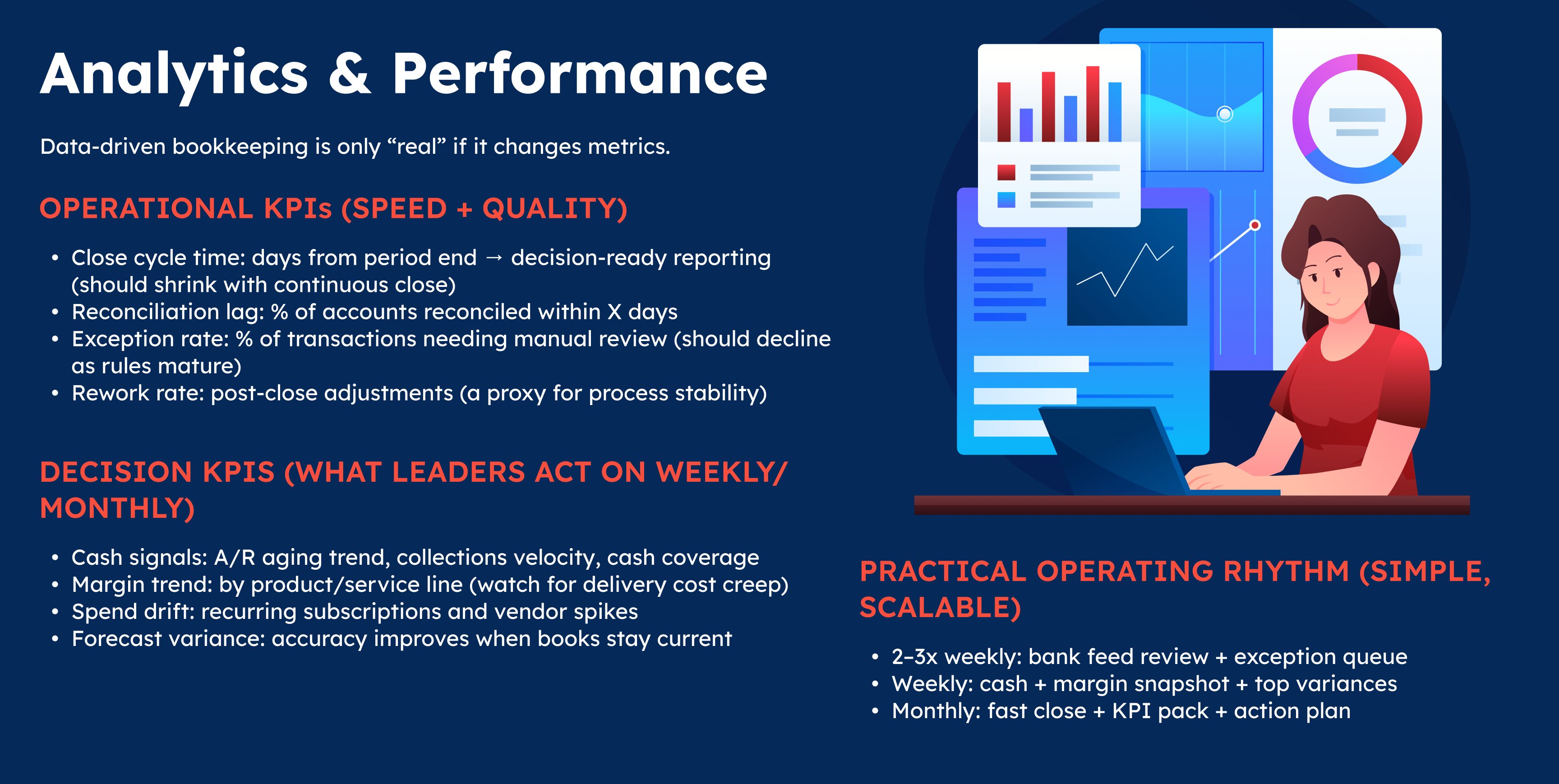
Traditional bookkeeping produces historical statements. Data-driven bookkeeping produces operational signals: margin shifts, spend drift, cash pressure, and A/R risks—while there’s still time to act. The move toward continuous accounting/continuous close is a big driver of this shift, because it keeps data updated and accessible in near real time.

Faster closes, fewer surprises
When reconciliations, coding rules, and exception handling happen throughout the month, month-end becomes finalization—not a scramble. This reduces errors and makes financials more stable and repeatable.

Automation makes “always-current” books realistic for SMBs
Bank feeds and automated matching reduce manual entry and speed up reconciliations—freeing time for review and analysis. Xero specifically cites time savings from bank feeds and automated transaction matching.

Better alignment with where the profession is heading
Accounting bodies increasingly emphasize technology, data, and analytics as core future capabilities. IFAC, for example, highlights data capabilities as key to accountants’ future relevance.
Where Xerosoft Global fits: Xerosoft Global can position services around building an “analysis-ready” finance workflow: automated capture + strong controls + KPI packs that leadership actually uses.

Conclusion
Data-driven bookkeeping is the future because it turns accounting from a reporting function into a management system. Continuous close practices and bank-feed automation make timely, reliable data achievable—even for growing businesses.
With the right setup, Xerosoft Global can help firms standardize workflows, improve controls, and deliver performance reporting that drives smarter decisions—not just compliant statements.
References
- Oracle NetSuite — Continuous Accounting Defined
- Oracle NetSuite — The Continuous Close: What It Is
- Xero — Connect Your Bank (bank feeds + automation)
- Xero Blog — Bank feeds myth-busting (time savings + reduced manual entry)
- IFAC — Data and the Future-Fit Accountant