Corporate tax “compliance gaps” usually come from the same root causes: manual data handoffs, inconsistent documentation, late issue discovery, and rules that change faster than internal checklists. In 2026, modern corporate tax filing software is increasingly closing those gaps by standardizing data, embedding validations, and creating defensible audit trails—so errors are caught before filing, not after a notice arrives.
Key Benefits

Built-in validations catch errors earlier than manual review
E-filing ecosystems increasingly rely on structured schemas and business rules that can be validated systematically. For example, the IRS Modernized e-File (MeF) program distributes schemas and business rules that software can use to validate returns and reduce XML/format-related failures.
Compliance gap closed: “We filed, but it got rejected / returned due to formatting or rule failures.”

Standardized workflows reduce missed steps (and key-person risk)
Tax filing software replaces spreadsheet-driven processes with consistent workflows: task routing, sign-offs, and status visibility. That reduces the common gap where compliance depends on one person’s memory or a static checklist.

Better handling of e-file rejections and exceptions
When rejections do happen, platforms and vendor guidance often map rejection codes and validation issues to specific fixes—making resolution faster and reducing repeat failures.
Compliance gap closed: repeated resubmissions, late acceptance, and penalty exposure tied to avoidable rejections.

Continuous regulatory updates reduce “out-of-date rules” exposure
Corporate tax software vendors position their platforms around keeping up with regulatory complexity and reducing compliance risk through automation and controls.
Compliance gap closed: using last year’s logic (rates, forms, thresholds, reporting formats) because internal updates didn’t keep pace.

Alignment with tax authorities’ digital direction
Tax administrations are pushing digital transformation—moving toward more integrated, data-driven compliance models. The OECD notes that digital transformation aims to make compliance easier and less costly, and highlights the shift toward more technology-enabled approaches.
Some administrations are also exploring machine-readable law to enable more automated calculations and checks.
Compliance gap closed: mismatches between how businesses manage tax internally and how authorities increasingly expect data to be structured and transmitted.

Conclusion
Corporate tax filing software closes compliance gaps by moving companies away from manual, deadline-driven processes and toward structured data, embedded validations, controlled workflows, and defensible audit trails. With authorities modernizing e-filing standards (schemas/business rules) and broader digital transformation accelerating, automation is increasingly the practical path to fewer rejections, fewer missed steps, and faster, more reliable filings.
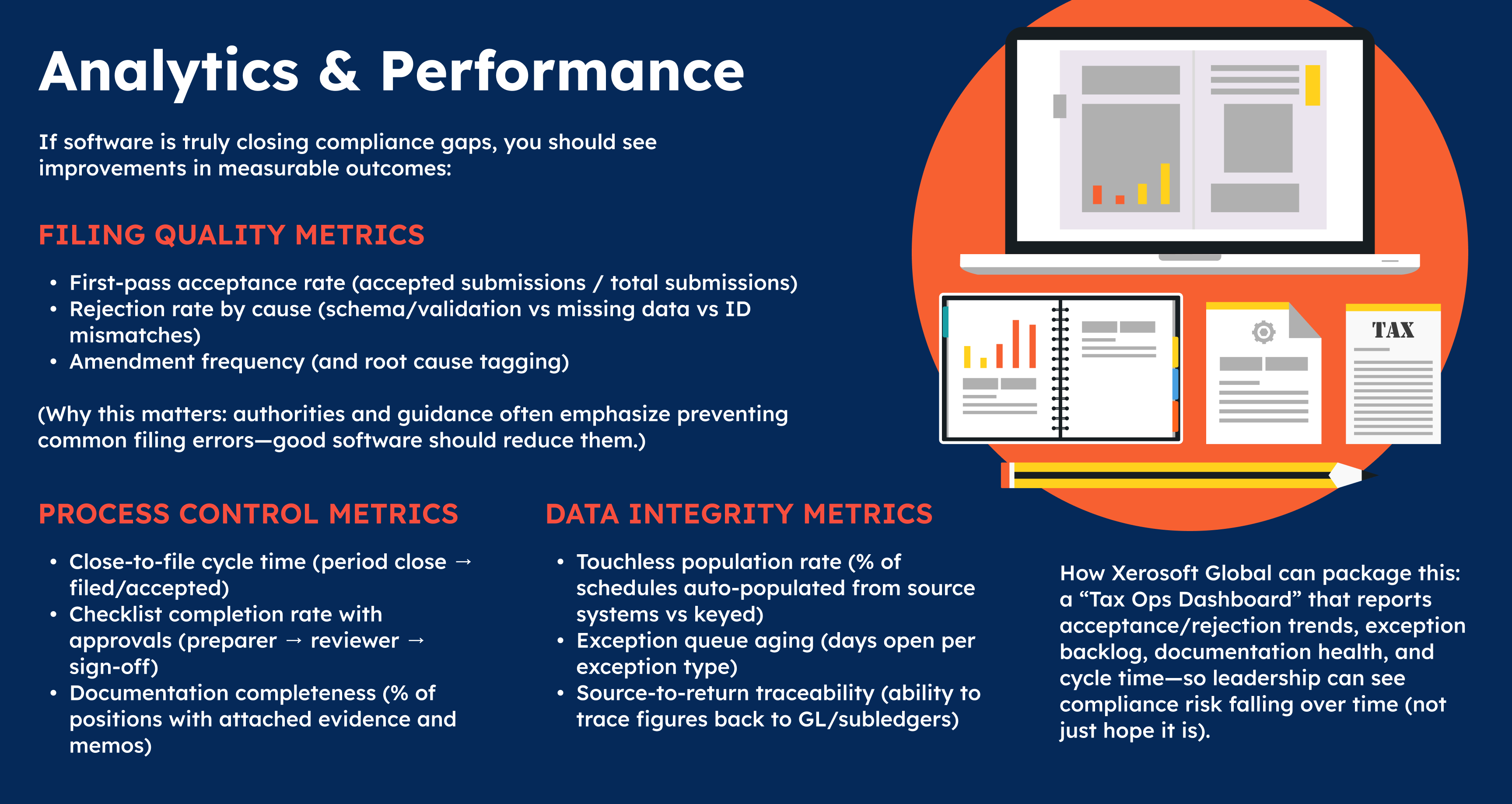
For organizations that want that outcome without an internal overhaul, Xerosoft Global can help implement the operating model around the software—process design, controls, exception management, and performance reporting—so compliance improvements are durable.
References
- IRS — Modernized e-File (MeF) schemas and business rules
- IRS — MeF schemas and business rules resources (technical guidance hub)
- OECD — Digital transformation of tax administration
- OECD — Tax rule management and application (machine-readable law; compliance checks)
- Thomson Reuters — ONESOURCE corporate tax software & services