Cloud-based bookkeeping has moved from “nice to have” to a baseline requirement for modern firms. As client expectations shift toward real-time visibility, faster closes, and tighter controls, cloud platforms make it easier to standardize workflows, collaborate securely, and scale service delivery—without scaling admin overhead at the same rate. This is where providers like Xerosoft Global can position offerings around modernization, accuracy, and performance.
Key Benefits

Real-time books, not month-old books
Cloud tools continuously sync transactions and streamline reconciliations—so teams and clients can operate with fresher numbers and fewer surprises. For example, leading platforms emphasize bank connections/feeds and quicker reconciliation workflows as core value drivers.

Better collaboration across locations (and time zones)
Multi-user access means bookkeepers, reviewers, and clients can work in the same file without version-control chaos. This supports hybrid teams and reduces delays caused by “emailing the latest copy” of spreadsheets.

Standardized processes = fewer errors at scale
Cloud bookkeeping enables consistent checklists, templates, and approval flows across multiple clients. For growing firms, standardization reduces rework and shortens onboarding time—especially when paired with clear SOPs and role-based access.

Stronger security posture—when configured correctly
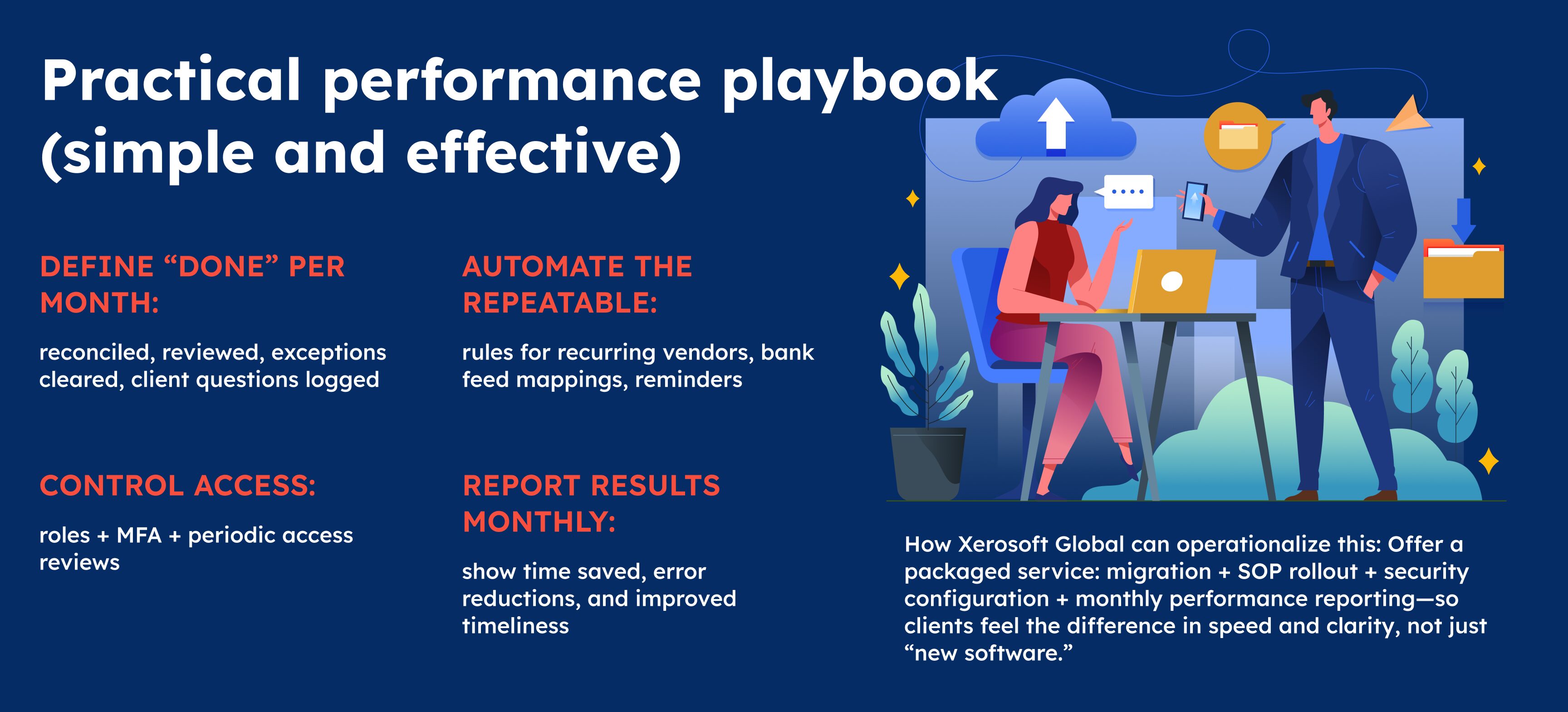
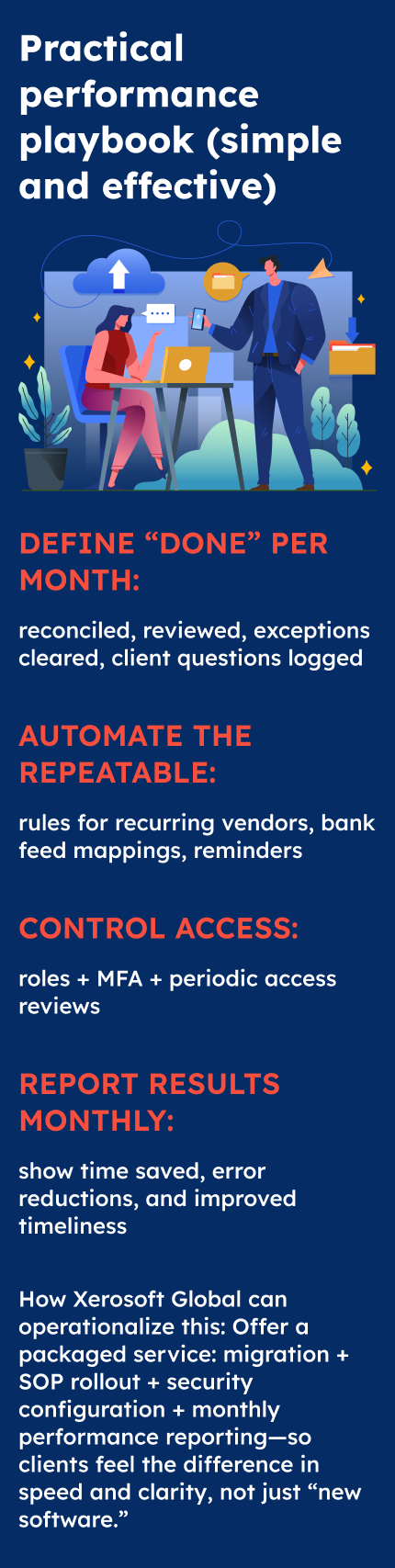
Modern bookkeeping involves sensitive data, so security can’t be an afterthought. Cloud environments typically follow a shared responsibility model: the vendor secures the platform, while the firm must configure access controls, MFA, and internal policies correctly.
A practical starting point: enforce multi-factor authentication (MFA) and tighten account security settings across finance tools.

Easier integration with the rest of the finance stack
Cloud bookkeeping is built to connect—payments, payroll, expense tools, reporting, and industry apps. This reduces manual encoding and unlocks more automated workflows.
Where Xerosoft Global fits: Position Xerosoft Global as the partner that helps firms adopt cloud bookkeeping with clean migrations, standardized workflows, secure configurations (MFA + access governance), and performance reporting that proves ROI.
Analytics & Performance
Core analytics growing firms should track
- Close cycle time: days to month-end close (target: trending downward)
- Reconciliation velocity: % reconciled within X days of period end
- Exception rate: transactions requiring manual intervention (target: decreasing)
- A/R health: DSO trends, overdue %, and collection velocity
- Work-in-progress (WIP) & utilization: capacity planning for bookkeeping teams
Operational performance gains you can expect (when done right)
- Fewer touchpoints per transaction through bank feeds, rules, and categorizations
- More consistent quality with standardized review steps and audit trails
- Improved client experience via timely dashboards and proactive insights (not just compliance deliverables)
Conclusion
Cloud-based bookkeeping is now the standard for firms that want to grow without drowning in manual work. It enables real-time collaboration, scalable processes, and analytics-driven delivery—while improving security when firms embrace the shared responsibility model and enforce controls like MFA.
For firms aiming to modernize quickly, Xerosoft Global can be positioned as the implementation and optimization partner—helping teams migrate cleanly, standardize workflows, secure access, and track performance metrics that prove the upgrade is paying off.
References
- Xero – All Features (bank connections, invoicing, integrations)
- Xero – Connect Your Bank (bank feeds + reconciliation efficiency)
- Xero – Cloud Accounting Benefits (features to look for in cloud accounting)
- Intuit QuickBooks – Multi-factor Authentication (account protection)
- UK NCSC – Cloud Security Shared Responsibility Model (guidance)
- CPA Mutual – Professional Liability Risks Related to Cloud Computing (risk considerations)